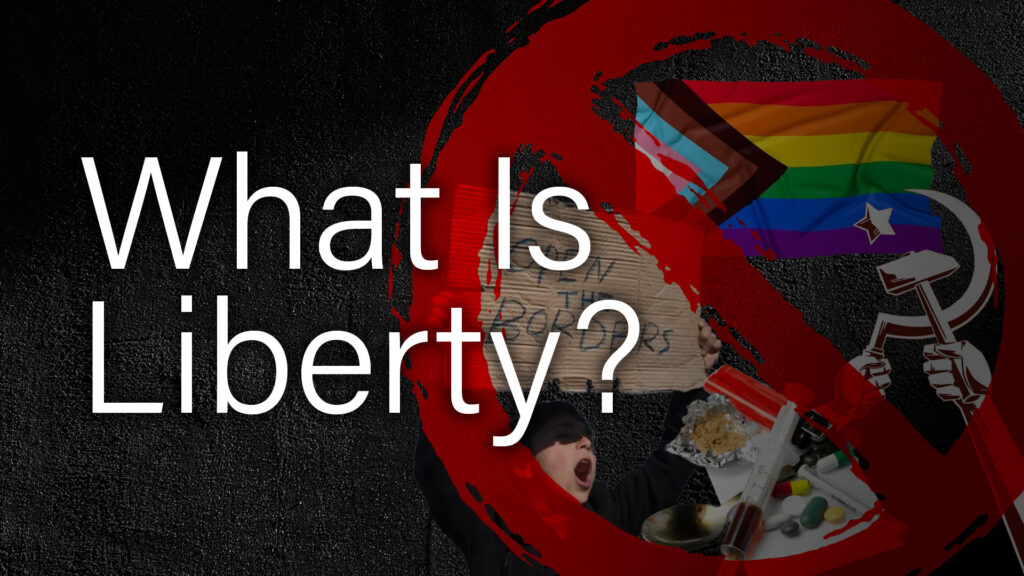
There has never been more confusion surrounding a given ideology than there is around libertarianism—especially in the United States. Even within “libertarian” circles, we can’t seem to agree on what it means. Do we support open borders? Do we support giving meth to children? (The answer to both is no.) The root problem is that libertarianism keeps getting treated like a personality type, a religion, or a lifestyle brand, instead of what it actually is: a political philosophy about the limits of state power.
Libertarianism is the belief that government is a blunt, inefficient tool for shaping society, and that voluntary cooperation (families, communities, institutions, markets, and culture) does a better job of producing prosperity and human flourishing. Nowhere does that imply that we must suspend moral judgment, stop advocating for cultural standards, or refuse to call out wrongdoing. It means we reject the idea that the state should be the primary enforcer of virtue.
Culture & Morality
One of the most common errors is the claim that libertarians should take no stance on cultural issues. In practice, that “neutrality” often becomes surrender: refusing to defend norms or moral boundaries while activists aggressively reshape them. Some people confuse “liberty” with “anything goes,” as long as the magic word consent gets invoked, even in situations where consent is meaningless, coerced, or impossible, especially involving children. These are the primary differences between libertarians and “cultural libertines” who are essentially moral relativists and hedonists, and not actually libertarian.
Libertarianism depends on a moral and responsible populace. If you remove the nanny state, you do not remove standards, you shift responsibility back to society. What other levers do we have to persuade our neighbors away from destructive behavior if not persuasion, shame, community norms, private institutions, and strong families? You don’t need government to say, “This is wrong.” And in a freer society, it becomes even more important that good people are willing to say it out loud.
Libertarianism is ordered liberty: rights and boundaries, not chaos. The point is to limit government, not to become an advocate for every cultural trend, and not to pretend that every “lifestyle choice” is morally equal or socially harmless. Plainly put, libertarians aren’t called to be advocates for homosexuality or gay marriage, we are called to advocate for government to remove itself from marriage entirely.
Economics & Free Markets
Libertarianism is inseparable from economics because freedom isn’t just the first and second amendments, it’s also whether you can work, trade, build, and keep the fruits of your labor.
This is why “libertarian socialism” is a contradiction. Socialism, as implemented, requires an authority that controls property, production, and exchange. That control requires coercion. Libertarianism is built on voluntary association and private property—meaning you can form co-ops, communes, shared ownership models, or mutual aid networks all day long, as long as participation is voluntary, privately controlled, and exit is allowed. The moment you require it by force, or establish it via the state, it stops being libertarian.
Free markets create prosperity not because people are angels, but because incentives and feedback are real. Competition forces businesses to serve others better. Prices convey information about scarcity and demand. Profit and loss reward what works and punish what wastes. Over time, that spontaneous order produces more innovation, more choice, and higher living standards.
State intervention often does the opposite: it shields failure, entrenches incumbents, and turns entrepreneurship into lobbying. Subsidies, bailouts, and regulatory mazes don’t “protect the little guy”, they create artificial monopolies and corporate welfare, letting companies circumvent the need to compete because they’re propped up by taxpayer money. That isn’t capitalism; it’s cronyism dressed up as compassion.
Immigration & Open Borders
Immigration tends to be a more contentious topic even among libertarians, but it’s incredibly relevant now, especially given the tension we see in places like Minnesota. Libertarians generally support freer immigration in principle because peaceful people who want to work, contribute, and build a life should have a path to do so. That does not mean “open borders” or “no enforcement.” It means we should fix a system that is both unjust and dysfunctional: too hard for good people, too porous for bad actors and welfare leeches.
A major source of public conflict is the combination of a broken immigration system and a large welfare state. When benefits are abundant and enforcement is weak, incentives get warped and resentment grows. Libertarians have long argued that reducing government welfare distortions would reduce much of that pull, while also lowering the political temperature around the issue.
Conservatives often over-correct by treating every illegal immigrant as a violent criminal. Progressives often over-correct by acting as if borders and enforcement are inherently immoral. There is an obvious middle ground: make legal immigration easier for people who want to assimilate and contribute, and prioritize the removal of violent criminals and repeat offenders who harm Americans.
Even in an anarcho-capitalist society, private borders would exist and would be enforced. And many libertarians aren’t anarchists anyway; they support a minimal state that still has core responsibilities, including national defense and protecting citizens from foreign threats. That is not compatible with open borders.
Drugs & Medical Freedom
Libertarianism has never been “pro drug use.” It’s about liberty and reality.
First, the government should not own your body or dictate medical decisions, especially after watching how reckless and coercive public health authority can become (Covid-19 “vaccines” anyone?). Second, prohibition often fails to address the underlying demand for drug use and tends to create black markets, violence, and corruption on top of the original problem. One only needs to look at the CIA to understand the depths of the corruption.
None of that implies celebrating addiction, excusing coercive drug dealing, or pretending that selling drugs to kids is acceptable. Protecting children is not optional, and “consent” is not a magical shield for predators, dealers, or black market manufacturers who engage in coercive measures. The libertarian claim is that adults should be free to make informed choices about their own bodies, and that civil society (families, churches, employers, private organizations, and communities) should be empowered to discourage destructive behavior and help people recover without outsourcing everything to the state.
It’s also true that certain controlled substances have legitimate medicinal uses and should be evaluated honestly rather than filtered through bureaucracy, politics, and industry capture. Medical freedom is about reclaiming health and truth, not defending self-destruction.
The Purpose of Libertarianism
Libertarianism is not “do whatever you want and nobody can say anything.” It is a political philosophy that limits government and places responsibility back where it belongs: on individuals, families, and communities. In a freer society, we don’t become moral cowards, we become adults again.
End the FED.